
Hamnet (2025)
Chloé Zhao’s Hamnet operates within what you might call an uncomfortable paradox. It takes literature’s most celebrated meditation on death and mortality, traces it back to a real child’s plague-ravaged body, and asks whether the alchemy of grief into art represents transcendence or something closer to betrayal. Adapted from Maggie O’Farrell’s novel, the film speculates on how William Shakespeare’s eleven-year-old son became, through an accident of spelling and a father’s desperation, the Danish prince who never quite decides whether existence is bearable. This is territory that invites missteps at every turn.
The narrative begins in 1580s Stratford with impoverished Latin tutor William (Paul Mescal) encountering Agnes (Jessie Buckley), a healer whose knowledge of herbs and natural remedies has earned her a reputation for witchcraft. Their courtship unfolds with tactile immediacy. Zhao captures the sensory texture of pre-industrial life without romanticising the mud and mortality that characterised the period. Early scenes of domestic life, of children playing, of small rituals and ordinary tenderness, acquire weight precisely because we sense what’s coming. When plague claims their son Hamnet, the couple’s marriage fractures along predictable fault lines. Agnes grieves with her whole body. William, absent in London pursuing theatrical ambitions, converts his pain into iambic pentameter.
Buckley’s performance has generated considerable acclaim, and rightly so. She embodies Agnes with such raw conviction that watching her navigate catastrophic loss becomes almost unbearably intimate. There’s nothing calculated about it. Mescal provides necessary counterbalance: his Shakespeare is quieter, more interior, a man discovering that grief can be deferred but never evaded. Emily Watson, as William’s mother, anchors the supporting cast with the kind of understated authority that reminds you how much historical suffering went unrecorded and unmourned.
Zhao’s visual approach remains her signature strength. The film treats the natural world as mystical without tipping into sentimentality. Falconry sequences, the preparation of medicinal herbs, the quality of light filtering through Warwickshire trees: these elements suggest that meaning resides in particulars rather than abstractions. It’s a sensibility that serves the material well, though occasionally the tonal shifts between contemplative observation and emotional crescendo feel jarring.
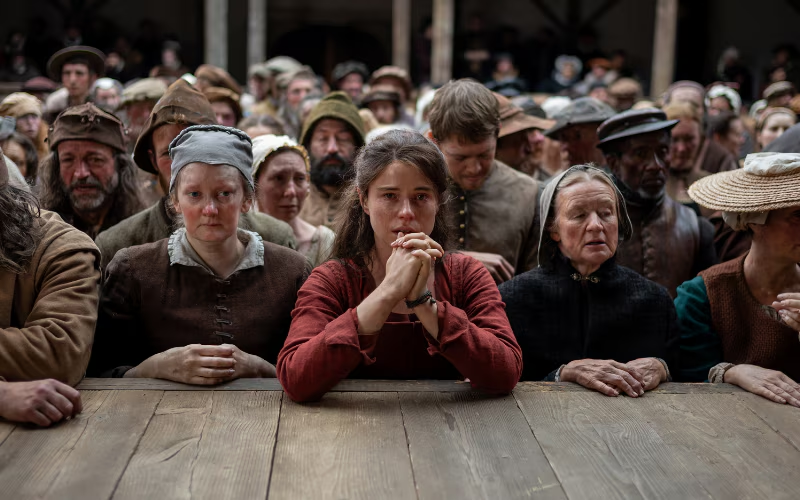
The film’s central proposition, that Hamlet emerged directly from Hamnet’s death, walks a fine line. Some sequences lean too heavily on the connection. William composing “To be, or not to be” beside a river, for instance, feels rather on the nose. Yet the climactic staging of Hamlet itself proves genuinely affecting. Watching Agnes begin to comprehend what she’s witnessing, how her son’s death has been transformed into public spectacle and communal catharsis, the film crystallises its implicit question: does art honour loss or merely repurpose it?
Where Hamnet stumbles, in my view, is in its relationship to suffering. Zhao lingers in moments of anguish with such intensity that the camera’s gaze begins to feel exploitative rather than empathetic. There’s a difference between bearing witness and voyeurism. The film doesn’t always respect that distinction. Additionally, the use of Max Richter’s overexposed “On the Nature of Daylight” undermines the period authenticity the production otherwise achieves. When a piece of music has soundtracked half the prestige television of the past decade, deploying it here feels lazy.
Still, Hamnet succeeds more than it fails. It recognises that art cannot redeem unbearable loss, only make it communicable. That the film articulates this understanding with considerable craft and anchors it in two extraordinary central performances counts for something substantial.