
Sentimental Value (2025)
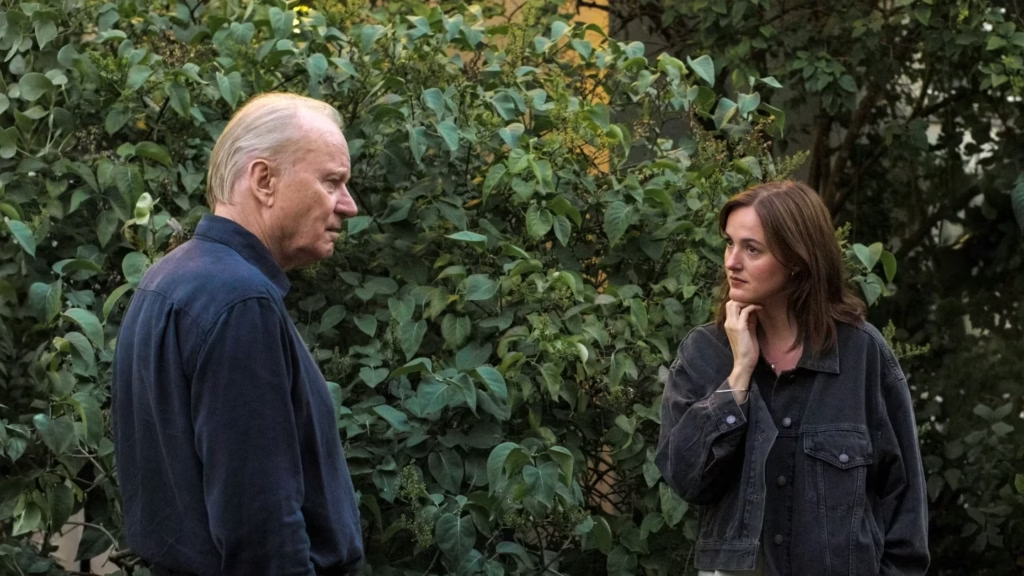
Joachim Trier’s sixth film asks a question that sounds simple until you think about it properly: can art repair what life has broken? The Norwegian director has spent his career watching people try to make sense of their emotional wreckage without resorting to therapeutic clichés, and Sentimental Value might be his most unflinching attempt yet. It’s a film about family estrangement, creative desperation, and the uncomfortable possibility that sometimes reconciliation is just manipulation wearing better clothes.
Gustav Borg (Stellan Skarsgård) is a once-celebrated director whose career has stalled and whose relationship with his daughters has deteriorated past stalling into something closer to estrangement. When he reconnects with stage actress Nora (Renate Reinsve) and historian Agnes (Inga Ibsdotter Lilleaas) after their mother’s funeral, he comes bearing what he clearly believes is a gift: he wants Nora to star in his comeback film. The project centres on Gustav’s own mother, a Norwegian resistance fighter tortured by Nazis during the occupation who later hanged herself in the family home when Gustav was seven. He plans to shoot in that actual house. He wants to recreate the suicide for the film’s climax.
Nora, sensibly enough, refuses.
What follows is less a story about artistic vision than about the ways people use art to avoid actually dealing with their relationships. When American actress Rachel Kemp (Elle Fanning) takes the role instead, Netflix agrees to finance the project, and the production becomes a pressure cooker for every unresolved tension in the Borg family. Gustav treats Rachel with more patience and empathy than he’s ever shown his own daughters. Agnes watches him cast her young son in the film without asking her permission first, which reminds her bitterly of how Gustav once used her in a movie as a substitute for genuine fatherly attention. Nora, already struggling in her personal life (there’s a relationship with a married man that’s going nowhere), finds herself increasingly destabilised by her father’s presence and his apparent inability to grasp why his approach feels less like healing and more like exploitation with good lighting.
Trier grasps something essential about families that many filmmakers miss: reconciliation through art sounds profound in theory but can just be emotional manipulation dressed up in better rhetoric. Gustav genuinely believes he’s offering something meaningful. He thinks the film will create understanding, perhaps even forgiveness. But what he’s actually asking his daughters to do is perform that forgiveness on his terms, in his medium, according to his script. He wants them to say the lines he’s written. The film never quite lets him off the hook for this, even as it allows him his own legitimate pain and creative desperation.
Skarsgård delivers what I’d argue is his finest work in years. His Gustav is charismatic when he needs to be, self-absorbed when he can’t help it, occasionally tender, frequently impossible. He’s the sort of man who can offer genuinely insightful observations about art and emotion but seems constitutionally incapable of applying those insights to his actual relationships. There’s a scene where he buys inappropriate DVDs for his grandson and the moment of shared laughter with Nora feels like a glimpse of what their relationship might have been. Then it passes, and the weight of everything unresolved settles back.
Reinsve, reuniting with Trier after The Worst Person in the World, brings a coiled intensity to Nora. She’s someone who recognises her father’s patterns with depressing clarity but can’t quite stop hoping this time might be different. That hope is probably the most painful thing about her performance. Lilleaas provides a different register as Agnes, whose apparent stability turns out to conceal its own carefully maintained resentments. When she visits the National Archives to read her grandmother’s testimony about the torture (something her grandmother refused to discuss with anyone), the gesture suggests someone trying to understand family history outside her father’s artistic interpretation of it.
The production itself becomes troubled in ways that mirror the family dysfunction. Rachel can’t speak Norwegian and grows increasingly self-conscious about working in translation. Gustav resents Netflix’s involvement despite needing their money. The boundaries between the film-within-a-film and the actual family story blur in ways that feel both dramatically effective and psychologically accurate. Eventually Rachel quits, recognising that she’s become a pawn in someone else’s family drama. Gustav, drunk and furious, throws a middle finger at the house before collapsing. He ends up hospitalised. The film continues anyway, rewritten for a modern setting, shot on a sound stage rather than in the actual house. The compromise feels like defeat dressed up as pragmatism.
The film does lose its way occasionally in the middle section. Some of the tensions become repetitive rather than building properly, and the pacing tests patience at times. Trier introduces subplots (Nora’s affair, various production complications) that gesture at themes without quite developing them fully. The structure sometimes feels more interested in atmosphere than momentum.
But Sentimental Value achieves something genuinely difficult in my view. It examines how families inherit trauma across generations without reducing that inheritance to neat psychological patterns. It asks whether art can genuinely heal or whether it sometimes just provides another arena for dysfunction to play out with better production values. The title works on multiple levels: the objects and memories families cling to, the value we assign to creative expression, the sentimental impulses that can be both genuine and manipulative depending on context.
Kasper Tuxen’s cinematography and Olivier Bugge Coutté’s editing give the film visual confidence without showiness. The story unfolds in chapters separated by cuts to black, creating a rhythm that feels closer to literary fiction than conventional drama. There are visual allusions to Bergman’s Persona, particularly when Rachel dyes her hair to resemble Nora. Whether those allusions add depth or just announce the film’s influences is debatable.
In its strongest moments, Sentimental Value understands that reconciliation isn’t always possible or even necessarily desirable, but understanding might be. That’s a more ambiguous conclusion than most family dramas offer, and probably a more honest one. Some relationships don’t get resolved. Some wounds don’t heal just because someone makes art about them. Sometimes the best you can hope for is a shared cigarette and a moment of genuine laughter before everything settles back into its familiar, painful patterns.