
All That’s Left of You (2025)
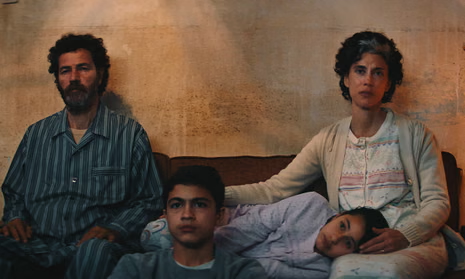
Some films document history. Others make you feel it sitting on your chest. Cherien Dabis’s All That’s Left of You is, in my view, firmly in the second camp — a multigenerational Palestinian family epic that earns its considerable emotional power through discipline and craft, and a refusal to let the political swallow the personal whole.
The film’s entry point is the Occupied West Bank in the 1980s, where a Palestinian teenager becomes caught up in a protest that reshapes everything. In its aftermath, his mother Hanan — played by Dabis herself, with an authority that seems hard-won rather than performed — begins to recount how they arrived at this particular precipice. That account pulls us back to Jaffa in 1948, where her father Sharif watches his ancestral home come under bombardment and makes the agonising decision to move his family to Nablus, staying behind himself to negotiate with approaching forces. From there, the film moves across four chapters and seven decades, tracing three generations of the Hammad family through displacement, resistance, loss, and a resilience that, to the film’s considerable credit, refuses to be romanticised into something tidy.
What sets Dabis apart here is her resistance to the consolations of sentimentality. This is a film acutely aware of how easily grief can be aestheticised into something palatable — something an audience can sit with comfortably and then file away. It largely refuses that option. The screenplay is episodic by design, and the earlier chapters can feel somewhat schematic as a result, which is, in my opinion, a fair criticism. Yet the film builds with unusual force as it moves toward its final act, suggesting that the patience it demands of its characters is also, quite deliberately, demanded of us. Not every film earns that kind of patience. This one does.
The performances deserve more than a passing mention. The Bakri family — Mohammad, Adam, and Saleh — bring a generational weight to their respective roles that feels less like inspired casting and more like an act of cultural memory in itself. Their collective embodiment of the same lineage across different eras is achieved with a naturalism that sidesteps the usual hazard of multigenerational dramas, where characters in different time periods can sometimes seem to be performing in entirely different films and occasionally are. Dabis herself, as Hanan, anchors the film’s emotional centre with a restraint that makes her moments of fracture all the more arresting.
Technically, the film is accomplished throughout. The cinematography shifts register across the decades without drawing attention to its own cleverness. The production design is seamlessly convincing — which is, frankly, remarkable given that the Gaza war forced the entire production to relocate from Palestine to Cyprus, Greece, and Jordan before a single frame was shot. The score does what a good score should do: it is there, and then you realise it has been doing a great deal of work without announcing itself.
There is something worth sitting with, beyond the film’s immediate subject. At its core, this is an inquiry into what passes between generations whether or not those generations have consented to receive it — the way memory functions not merely as inheritance but as obligation, and how identity persists when the physical markers of belonging have been methodically erased. These are not exclusively Palestinian questions. But the film insists, rightly in my view, on rooting them with absolute specificity in Palestinian experience. Universality, when it is earned this way, hits considerably harder.
All That’s Left of You is a strong, important, and genuinely moving piece of cinema. It will, I suspect, occupy a corner of your thinking long after you have left the cinema and resumed your ordinary life. Which is, when you consider how much film is made each year that does precisely nothing of the sort, no small achievement.