
H Is for Hawk (2025)
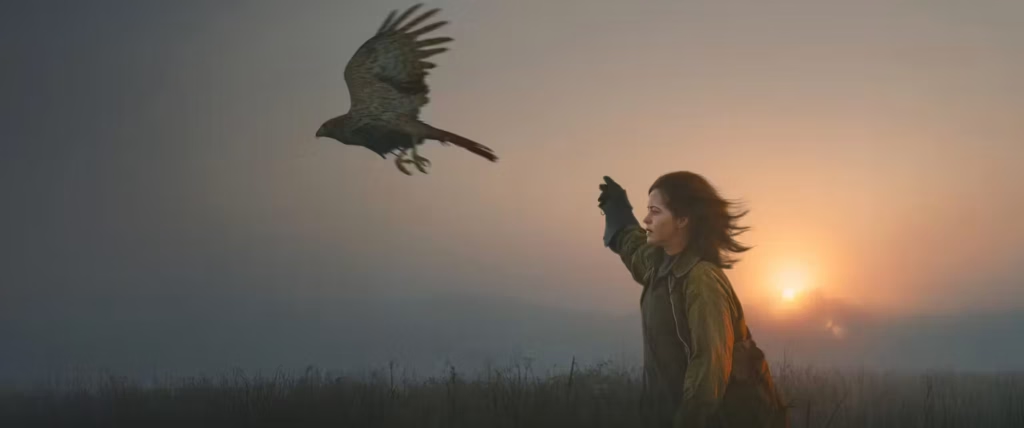
Claire Foy is, in my opinion, one of the finest screen actors working today, and H Is for Hawk uses her well. She plays Helen MacDonald, a Cambridge academic and ornithologist who, in 2007, loses her father Alisdair, a warmly mischievous press photographer played by Brendan Gleeson with such easy luminosity that his early disappearance from the film registers as its own small bereavement. When news of the death arrives, Helen forgoes counselling, withdraws from friends and family, and acquires a goshawk.
The bird, named Mabel, a name that sits oddly on a creature that could take your eye out, though perhaps that is the point, becomes Helen’s consuming obsession. Training a goshawk requires patience, raw meat, sustained eye-contact avoidance, and what one breeder in the film memorably recommends as a capacity for “murder.” Whether Helen possesses all four is the question the film works towards.
Director Philippa Lowthorpe, working from Emma Donoghue’s adaptation of Helen Macdonald’s prize-winning 2014 memoir, makes a film of genuine visual care. Charlotte Bruus Christensen’s cinematography is at its most alert in the goshawk sequences, attending closely to the bird’s speed and unpredictability, and the camera does not flinch when Mabel does something alarming. When she flies, you understand why a grieving woman might choose feathers and talons over the carefully worded sympathies of colleagues who do not quite know what to say.
Foy trained extensively in falconry, and the scenes show it. There is no visible trickery in the handling sequences, no protective cuts to spare her from the animal’s behaviour. The performance is physical as well as emotional: loss sits in her posture, in the particular blankness with which she stares at a restaurant curry while a nervous waiter edges a conciliatory dessert towards her. She conveys grief as a slow hollowing, a woman moving through the routines of a life she no longer quite inhabits.
The difficulty is that Macdonald’s memoir derived much of its power from the author’s interior voice, the way her mind ranged across falconry history, literature, and the life of writer T.H. White while grief did its slow subterranean work. Film has no natural equivalent for that kind of running interior commentary, and Lowthorpe declines the voice-over option. What remains is a portrait of behaviour without access to the thinking that drives it, and that gap never closes.
At 115 minutes, the middle section tests patience. The rhythms of training and withdrawal begin to repeat without accumulating. The supporting cast, including Gleeson in flashback sequences, Denise Gough as the worried friend Christina, and Lindsay Duncan as Helen’s mother, do excellent work in roles the script does not give enough room to breathe. Gough in particular has a stronger performance than the material around her can support.
These limitations prevent the film from reaching what its better passages suggest is possible. The portrait of a self-possessed, intellectually formidable woman choosing a primal and difficult relationship over the coping strategies her world expects of her carries a genuine charge. H Is for Hawk is a well-acted, sensitively made grief drama that does not fully honour its source. Foy’s performance is the main reason to see it.