
TRON: Ares (2025)
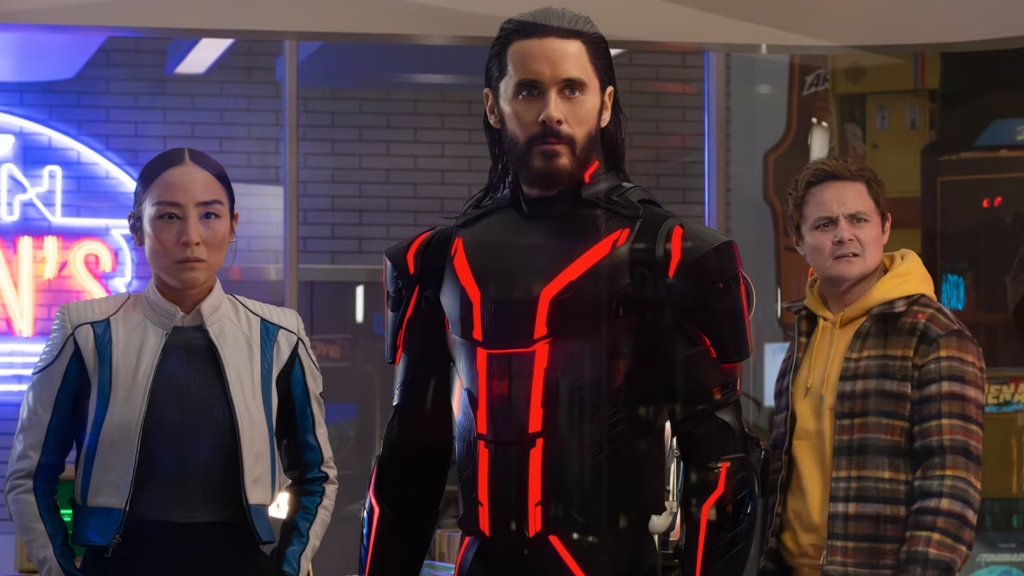
Joachim Rønning’s third crack at Disney’s intermittent franchise delivers exactly what you’d anticipate from a legacy sequel, which is both its strength and, frustratingly, its limitation. Spectacular visual craft? Absolutely. Thoroughly familiar storytelling? Also yes. The film dazzles your senses with considerable verve, though whether any of it lingers after you’ve left the theatre is another question entirely.
So what actually happens? Ares, a highly sophisticated programme, gets dispatched from the digital realm (the Grid, for the uninitiated) into our messy physical world on what we’re told is a dangerous mission. There’s a timer ticking down, though. Digital beings can only maintain corporeal form for 29 minutes before disintegrating back into code. The MacGuffin everyone’s chasing is the “Permanence Code”, something Kevin Flynn (Jeff Bridges, returning with his trademark twinkle) created that would let computer-generated entities stick around indefinitely. Corporate baddie Julian Dillinger (Evan Peters) wants this code for the usual power-and-profit reasons. Humanitarian tech CEO Eve Kim (Greta Lee) harbours loftier ambitions about solving global crises. Ares? He just wants to exist. Hard to fault him for that.
Visually, the film is spectacularly designed and directed within an inch of its neon-hued existence. Nine Inch Nails provides a techno score that adds philosophical depth, creating an intriguing tension with the kinetic action sequences. This remains the franchise’s greatest strength, really. If you’re going to see it (and there are worse ways to spend two hours), do yourself a favour: find the largest screen with the loudest sound system you can access. IMAX 3D or 4DX is where Rønning’s technical prowess genuinely shines.
But scratch beneath that luminous surface and you’ll find something rather hollow. The film decides to tackle the “what if AI gained sentience” angle, planting itself more firmly in real-world banality than in the visual splendour of the Grid. I say this with some regret: it’s well-trodden ground. The script brings little to the table that Blade Runner, Ex Machina, or (let’s be honest) even Short Circuit haven’t explored with more depth. The handling of artificial consciousness feels curiously sanitised, which is perhaps what happens when a major studio charts commercially safe waters.
Jared Leto’s performance as Ares is, oddly enough, fitting. He’s required to strip away so much humanity that he comes across as nearly one-dimensional, which actually works for a character just discovering what sentience means. The problem? That same flatness keeps the emotional core frustratingly out of reach. There’s a rather droll observation embedded in the film: perhaps AI won’t destroy humanity but will instead prove sanctimonious and tedious, all perfect skin tone and lingering, meaningful eye contact. Unfortunately, this rather describes the film’s own approach to its themes.
Consider the deeper questions simmering beneath the surface. Who should control transformative technology? How do we prevent the commodification of human advancement? Who gets to draw the ethical boundaries around creation itself? These questions deserve rigorous examination, in my view. The film nods towards them through its corporate power struggle but never commits to genuine exploration. There’s an irony worth noting: a film preaching humanitarian ideals, produced by a company that views sequels primarily as revenue streams. Make of that what you will.
Credit where it’s due, though. The soundtrack genuinely stands out as one of the film’s finest accomplishments. The action sequences deliver precisely what franchise devotees have come to expect. The film manages, somewhat impressively, to balance respect for its source material with fresh additions to the universe. You could walk in having never seen the previous instalments and still follow along without confusion.
TRON: Ares works best when you approach it as sensory spectacle rather than substantive science fiction. Think of it as a competently executed theme park ride: looks magnificent, sounds even better, but dissolves from memory at roughly the same rate its protagonist would without that elusive Permanence Code. If you want an uncomplicated visual feast, this delivers adequately. If you’ve been holding out hope that the franchise might finally achieve that balance between style and substance? Keep waiting.