
Disclosure Day (2026)
Steven Spielberg has spent his career looking up at the night sky with a shifting perspective. He gave us the wide-eyed wonder of a child in his early years, and later, the sweaty paranoia of a man clutching a flashlight in a dark basement. His latest film, Disclosure Day, occupies a curious middle ground between those two impulses. This film represents his thirtieth collaboration with composer John Williams. His score works heroically to lend majesty to events that the script downplays as mere bureaucratic secrets.
The narrative splits its focus between two apparently unrelated figures. Dr Daniel Kellner (Josh O’Connor) is a cybersecurity specialist turned whistleblower who walks out of a clandestine government contractor named the Wardex Corporation. He takes a stolen piece of extraterrestrial technology and a digital trove of data. This archive purports to prove that global authorities have covered up alien contact since the 1940s. Meanwhile, in Kansas City, a television meteorologist named Margaret Fairchild (Emily Blunt) experiences a bizarre domestic encounter. It leaves her speaking in tongues and possessed of strange, metaphysical insights. Eventually, Daniel’s flight from Wardex’s chief executive, Noah Scanlon (Colin Firth), converges with Margaret’s search for sanity. They are both drawn into an underground truth movement led by a government defector (Colman Domingo).
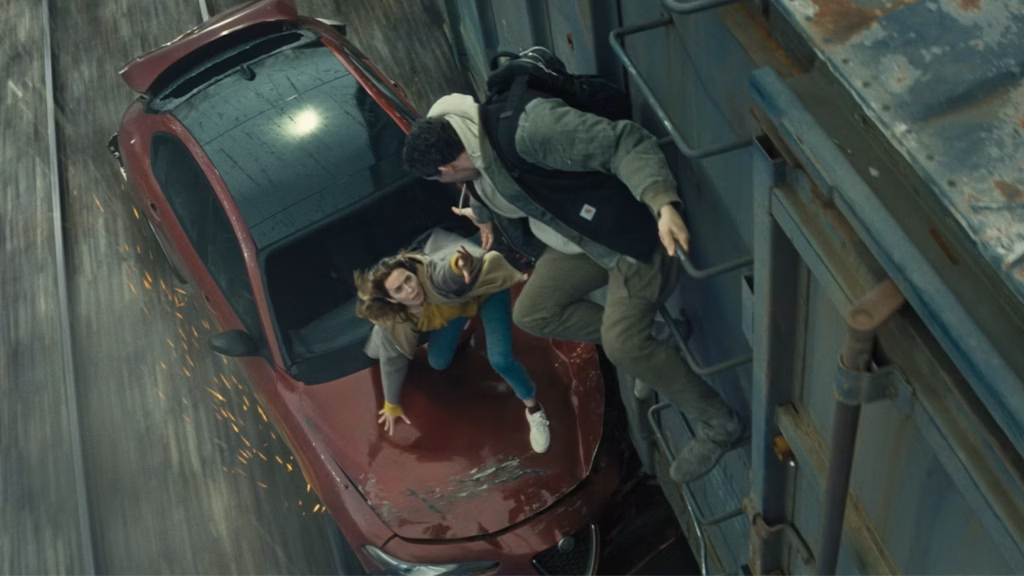
The film works best when it functions as a nimble, old-fashioned chase picture. Spielberg’s camera has lost none of its kinetic intelligence. He tracks characters through corridors and across landscapes with a fluid geometry. Most modern action directors look like they are operating a kitchen blender by comparison. O’Connor brings a crumpled, believable anxiety to the whistleblower. Blunt treats her weather presenter with a sharp, neurotic wit that prevents her supernatural affliction from becoming entirely ridiculous. There is a fine, dry irony in watching Colin Firth project chilly bureaucratic malice while hunting for a glowing piece of space hardware. He looks like an aggrieved floor manager dealing with a major inventory discrepancy.
David Koepp’s screenplay handles the mechanics of the chase with efficiency. It stumbles, in my opinion, when forced to articulate the grand implications of its premise. The film suggests that the long-standing cover-up was motivated by a patronising belief that human institutional structures, specifically our comforting religious and social structures, would collapse under the weight of cosmic company. When the script pauses to allow characters to debate whether humanity can intellectually or spiritually survive the truth, the momentum stalls. The dialogue shifts away from organic human speech, resembling an earnest panel discussion at a theological conference.
The climax feels uncomfortably safe. It resolves a massive existential crisis with a tidy emotional neatness that Spielberg has defaulted to in his later years. It is a film that asks grand, terrifying questions about our place in the universe, only to decide that the answer is a reassuring pat on the head. A minor Spielberg effort still displays supreme cinematic craft. This piece holds attention through pure technical execution, leaving the audience with an impeccably mounted but fundamentally down-to-earth experience.